Death Calls to You Again Ranger How Do You Answer
By C. J. Malcolm and Hannah Heinrich
There was no doubt in anyone's mind that search-and-rescue events (SARs) were skyrocketing in the 1990s at G Canyon National Park (fig. 1). In a 13-year span from 1983 to 1996, SARs doubled. The disquisitional tipping bespeak for this dangerous tendency occurred in summer 1996. That year, the park set records for search and rescues that remain in place to this mean solar day. 5 oestrus-related deaths, 300 oestrus-related search-and-rescue incidents, and 482 full SARs devastated families and stressed responding rangers to their limits. On boilerplate, SARs during the late 1990s at Yard Coulee National Park cost taxpayers $1 one thousand thousand per twelvemonth (Malcolm and Heinrich 2012). Something needed to change.
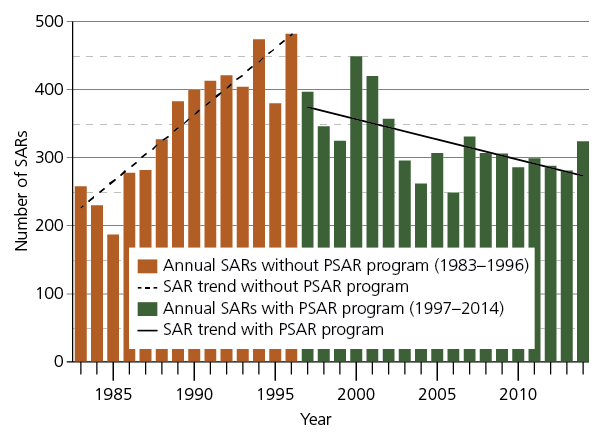
Ken Phillips, retired branch chief of Search and Rescue for the National Park Service and principal of Emergency Services at Thousand Canyon National Park, recounts the experiences of a Chiliad Canyon ranger during these challenging years.
In the summer months, the hottest months, we were totally in a reactionary mode and everything was based off the South Rim—unless a call was shut to Indian Garden or Phantom Ranch. As shortly as SAR Shift or back then, "SAR On-Call," … would receive a hiker-in-distress telephone call, they would start looking effectually for someone to transport down the trail. This happened every day, mean solar day in and day out; and if you lot have a couple of those calls a mean solar day, which we did, you beginning burning people out. You're simply running out of resource to practice that. For our responding rescuers the cumulative fatigue factor was insane considering you have got to blitz downwardly there; these were vague reports, "Somebody collapsed on the trail …" Well is that a cardiac arrest or is that somebody just sitting in the shade? Nosotros didn't know. Merely y'all tin can't filibuster your response. Oftentimes it involved running downward the trail. So imagine how fast you lot'd chew upwards responders running downwards the trail at the hottest fourth dimension of the twelvemonth. You get down there and y'all're sweating all over the patient, you lot're tied up on this call, and you lot're spent for the residue of the day. That's how the normal process went down before we were able to pre-deploy, before PSAR … This took an unbelievable toll on the staff.
After a decade of reactionary responses and the exigent year of 1996, rangers were exhausted and disheartened. The constant summertime requests for help created an surroundings of rescuer fatigue, burnout, and a muffled sense of situational awareness. Hazardous work atmospheric condition were accustomed and managed. As a result, park leadership deputed a planning group of 10 rangers with the goal of improving visitor prophylactic on Grand Canyon's many hiking trails and backcountry terrain. Their recommendation and call to activity created the Preventive Search and Rescue (PSAR) squad.
Evolution of PSAR: Best practices
Preventive search and rescue is a move that promotes rubber in arduous environments. For case, Yosemite National Park (California) focuses on educating visitors to utilise backcountry common sense, swift water safe, and public enjoyment of waterfalls from a distance. Yosemite implemented a permit system for climbing the popular Cable Road upwardly One-half Dome in summer 2010 in response to multiple fatalities from overcrowding. Delaware Water Gap National Recreation Area (Pennsylvania and New Bailiwick of jersey) uses PSAR to address water safety and proper utilise of personal flotation devices in an endeavour to reduce the number of drownings. At Grand Canyon, PSAR was established in 1997 with the mission of reducing company injury, illness, and death during the hottest summer months.
The original PSAR crew consisted of iv rangers who patrolled the Bright Angel and S Kaibab Trails. It is unclear how much time they defended to patrolling these trails, but according to original reports and corroborating interviews, PSAR rangers were either on the trail, interviewing hikers at trailheads, or staging at the Ranger Operations building. A strong volunteer strength was likewise organized to broaden the seasonal rangers for both trail patrols and rescue response.
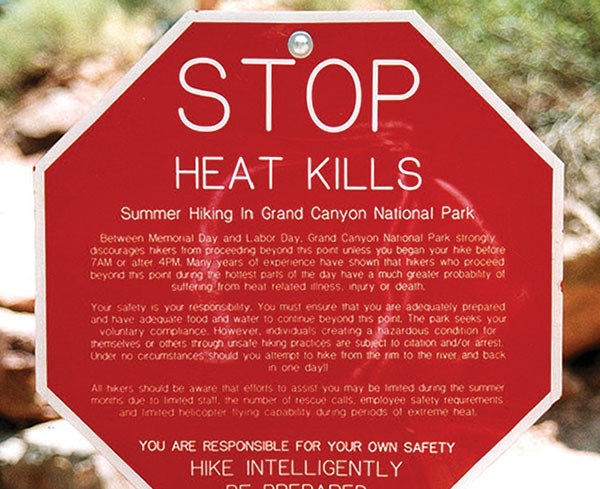
In add-on to the newly established staff of PSAR rangers, the park launched a media entrada with a "STOP, Estrus Kills" message (fig. two). Rangers posted signs along the corridor trails and distributed pamphlets, flyers, and full general data to the visitor centers, backcountry function, and other advisory areas throughout the park. Additionally, managers decided to close the Due south Kaibab trailhead to visitor parking, requiring the use of the M Coulee shuttle bus to access the popular trail. The lack of water availability in combination with this trail's sharp slope and farthermost sun exposure generated frequent rescues earlier creation of the PSAR program.
NPS Photo
Neb Vandergraff, longtime backcountry ranger and SAR proficient, said the closing of the South Kaibab trailhead to private vehicle traffic was instrumental in reducing the number of unprepared hikers from reaching this more problematic and challenging trail. "Prior to this closure," Ranger Vandergraff stated, "people would bulldoze in there, walk to the edge, look down, and get sucked right in. With the closure in identify in that location is effort required to become out to the South Kaibab Trail; the road is closed and you lot need to accept the shuttle bus. This has significantly reduced distress calls on the Due south Kaibab Trail."
Nineteen years later, the PSAR team has evolved into a close-knit group of rangers who are dedicated to inner coulee public condom through the awarding of emergency response skills and science-based planning. Over the concluding two decades, advances in engineering science, improved hiking gear, and increased availability of backcountry information take shaped the playing field on which PSAR operates. Today, preventive search and rescue has adopted the squad mentality and consists of seven seasonal rangers and ane total-time supervisor. In addition to paid rangers, the plan staffs sixty trained volunteers who supplement and amplify outreach efforts. Volunteers nourish a two-mean solar day training at the end of April followed past two to three days of shadowing rangers on trails, for a total of 30–40 hours of grooming for the busy time of twelvemonth.
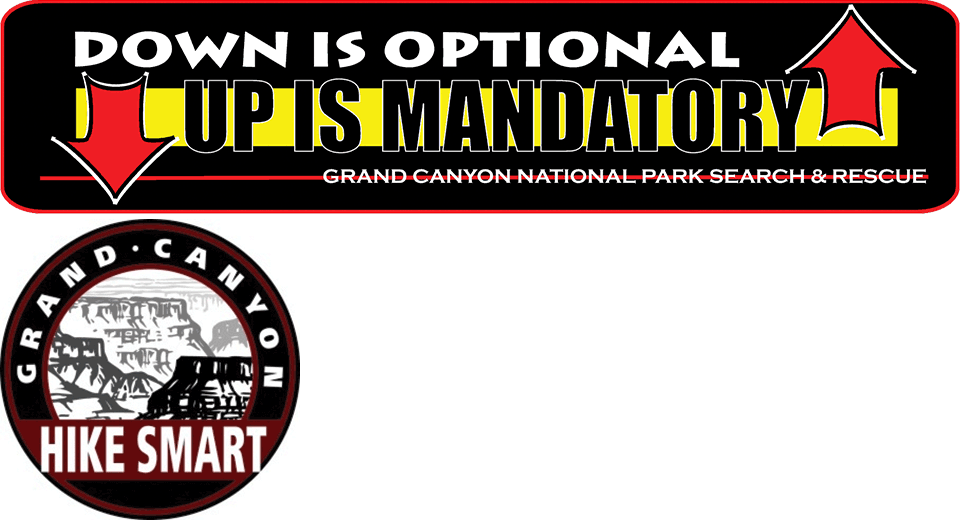
The PSAR season runs from April through Oct, with the bulk of trail patrols occurring from May to mid-September. The team now regularly patrols the Brilliant Angel, South Kaibab, Due north Kaibab, and Hermit Trails. Every solar day during the season, several rangers and volunteers deploy onto corridor trails and slowly patrol downward into the canyon. They accept positions at natural bottlenecks on the trails close to common balance areas; their goal is to brainwash visitors descending farther into the canyon on topics such equally personal preparedness and condom hiking practices. Many hikers take well-planned trips and many do non. Over the years, the original message of "End, Heat Kills" has evolved into "Hike Smart," a more personalized and positive messaging entrada (fig. 3). Prevention is achieved through signage in conjunction with face-to-face encounters every bit rangers and volunteers patrol the corridor trails.
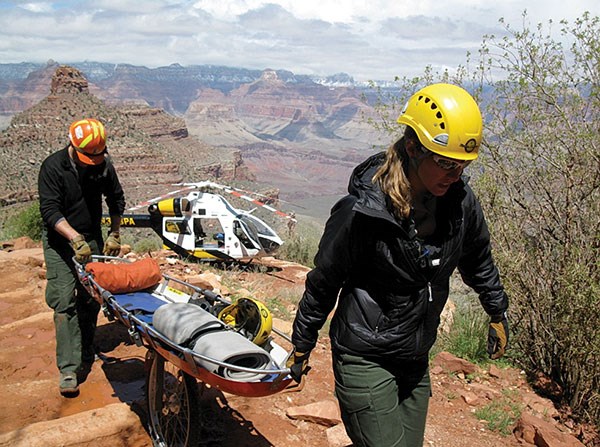
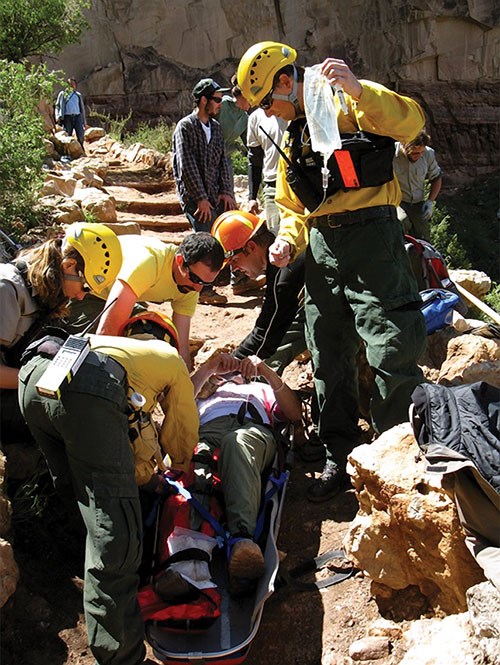
"Prevention through education" is PSAR'due south primary mission, although responding to down-trail medicals and SARs is only every bit important. When the plan was first established, PSAR rangers typically practiced at the first responder level. Today, all PSAR rangers are trained and certified to operate equally EMTs or paramedics in the backcountry, developed area or "front country" ambulance settings, and helicopter medevac environments. Rangers are also trained in search and rescue, technical rescue, and many other emergency response skills (figs. 4 and 5). The combination of patrolling 1000 Coulee's trails ane day and staffing the ambulance the adjacent generates a rich blend of experience, judgment, and skill. PSAR rangers need to be self-sufficient, educated, and prepared to atomic number 82 or guide those who are in damage's style. Ranger Vandergraff commented on the progression of PSAR over the past decade: "The level of professionalism past setting standards based on certifications, a ranger's grooming, and in-service group trainings has greatly improved our professional person response—an important component of public condom."
NPS/C. J. Malcolm
NPS/C. J. Malcolm
Search and rescue: A discretionary function
What is a SAR? While there are many definitions, search and rescue is the search for and provision of aid to people who are in distress or imminent danger. A SAR may exist every bit simple as assisting an individual with a sprained talocrural joint to return safely to a trailhead, as perilous as rescuing an injured climber on Rocky Mountain National Park's "Diamond" traditional climbing route, or as involved equally multiday searches for individuals lost at ocean or in wilderness settings. Saving lives is the ultimate goal of all search-and-rescue personnel.
The National Park Service further delineates SARs as major or minor, distinguished just by price: major SARs accrue costs greater than $500 while small SARs are less costly. Furthermore, expenses associated with major SARs are recoverable through almanac reimbursement by Congress. Staff hours, equipment replacement, and helicopter medevacs are typical items that can chop-chop inflate the expense of a rescue. The Park Service spends well-nigh $five meg annually rescuing visitors.
Is a park obligated to provide search and rescue? In a 1992 landmark decision, the tenth Circuit Courtroom of Appeals ruled in Johnson 5. Us Department of the Interior that search and rescue is a "discretionary function" of authorities that is protected under general rules of exception of the Federal Tort Claims Act at 28 U.S.C. § 2680(a). Mr. Johnson, described as an inexperienced mountain climber, fell to his death on Buck Mountain in K Teton National Park. His family after sued the Department of Interior challenge the park failed to properly warn him of the dangers of climbing and failed to initiate a rescue attempt inside reasonable time. The 10th Circuit legally affirmed NPS testimony that "(1) the inherent dangers of mount climbing are patently obvious; (two) both manpower and economic resources should be conserved … during emergency situations; (3) it would exist impractical if not impossible to test competency, monitor equipment use, or 'clear' the mount given limited bachelor manpower and economical resources; and (4) many park visitors value backcountry climbing as one of the few experiences free from authorities regulation or interference." The 10th Excursion Court of Appeals ruling further clarified a search-and-rescue squad's duty to respond, equally follows:
No statute imposes a duty to rescue, nor are there regulations or formal Park Service policies which prescribe a specific course of conduct for search and rescue efforts. Instead, the decision if, when, or how is left to the discretion of the SAR team. Therefore, the rangers must act without reliance upon stock-still or readily ascertainable standards when making a search and rescue decision in the field.
This judgment reaffirms that backcountry dangers are "obviously obvious" and safety of an individual is a personal responsibility. Yet, the National Park Service ardently strives to educate the public about wilderness dangers through solid preventive messaging.
Incorporating science
In 2011 a movement was initiated in preventive search and rescue to aggrandize the team's sensation and understanding of Grand Canyon hikers. We began to capture specific conditions indicators and trail data to serve as benchmarking tools for year-to-twelvemonth PSAR analyses and accountability. Rangers and volunteers at present complete daily patrol logs documenting key data components: trail hours, patrol times, trails patrolled, general contacts, preventive actions, hiker assists, and major medicals (fig. 6).
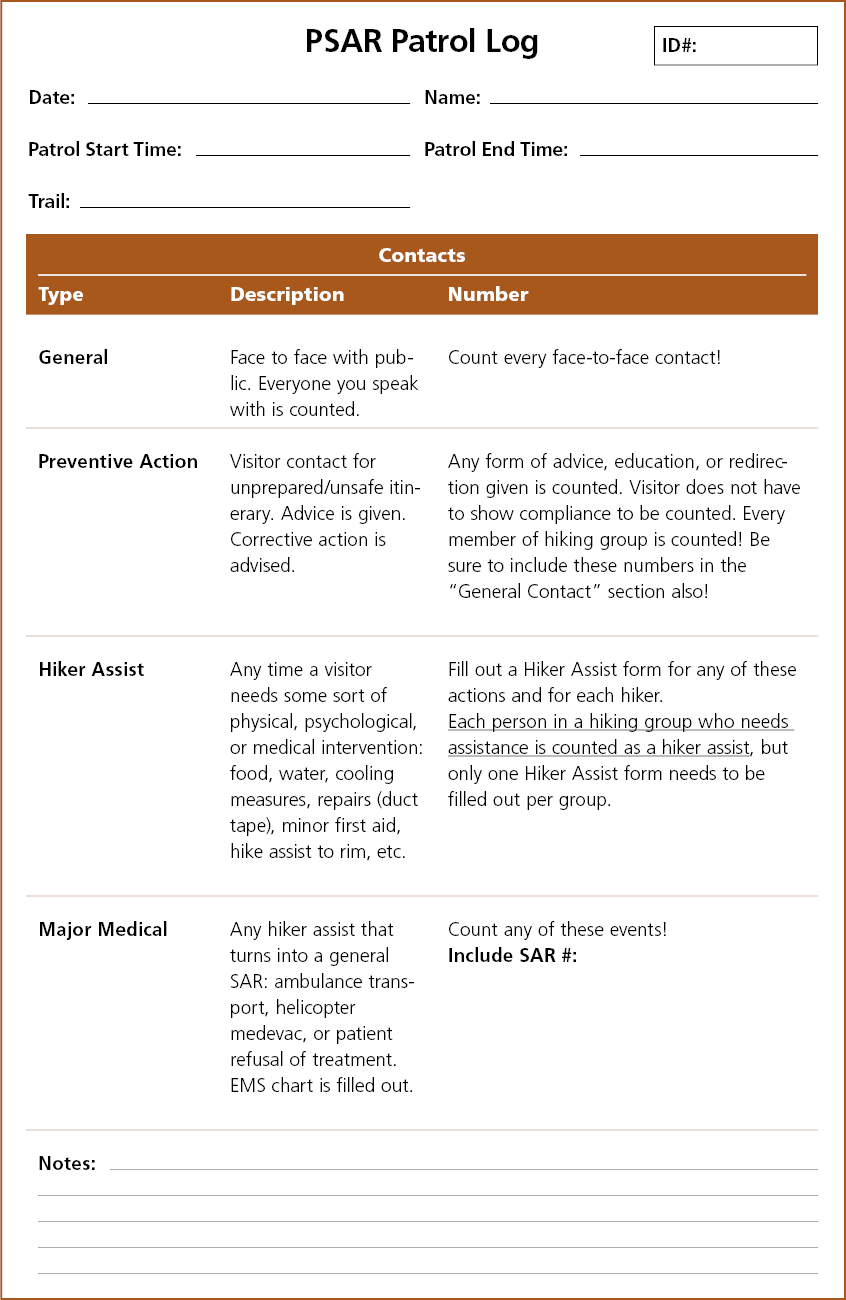
During patrols, members of the PSAR team tape the number of hikers they interact with on the trail. This is called a "general contact." A "preventive action" is recorded each time a ranger determines the demand to further educate a visitor, offering some form of corrective advice based on poor personal preparedness: hiking beyond i's abilities, inadequate food and h2o, improper vesture or gear, or lack of area knowledge and program. When a preventive action is recorded, a full general contact is counted as well (see fig. 6). The ratio of general contacts to preventive actions highlights 2 indicators: PSAR outreach and the level of preparedness amid those hiking in the coulee. A "hiker assist" documents each time a visitor requires concrete, medical, or psychological intervention by PSAR rangers or volunteers. Concluding, a "major medical" involves paramedic-level interventions that oftentimes require a litter-carry or helicopter medevac (see figs. 4 and 5).
Statistics on Grand Canyon's almanac SARs and hiker assists are kept as dissever figures; for example, an boilerplate of 300 SARs and an additional 530 hiker assists occur per year. Hiker assists characteristically are like in scope to modest SARs, merely are separated demographically to hikers in distress on corridor trails. However, when combined with Thousand Canyon's annual SARs, they demonstrate the overwhelming response of park personnel to backcountry travelers in need.
Throughout summer 2015 the PSAR team contacted 117,267 people hiking down Yard Canyon corridor trails (table 1). [1] Of these, 28,478 (24%) required some form of directive communication in the commitment of a preventive bulletin and safe hiking education. Three hundred fifty of those general contacts required assistance hiking out of the canyon, a "hiker assist." This type of assistance ranges from uncomplicated equipment repairs (e.g., shoes falling apart) to major heat illness interventions, such as rapid cooling, hydrating, and other advanced life support measures. PSAR rangers record hiker assists in more detail on a divide grade. A number of demographics and variables are gathered, such equally age, gender, location, need for assistance, and treatment or care rendered. Ranger hours spent patrolling trails are also trended and compared to annual park visitation, general contacts, and other indexes (table 2). [two]
[1] Table 1 reveals a decrease in hiker assists in 2014—a trend that connected into the early 2015 hiking season. 1 possible caption for the decline is that the PSAR training in 2014 was greatly enhanced, improving the skills and confidence of the patrol rangers and trail volunteers.
[two] Table 2 reveals a decrease in patrol hours in 2014. In item, afternoon patrols were reduced forth the Bright Angel Trail following installation of the new Indian Garden weather station, which allowed adjustments to be based on temperature. Along the North Kaibab Trail, patrol reductions were related to staffing and hiring problems during the first one-half of the year.
Tabular array 1. Contacts between PSAR staff and hikers forth M Coulee corridor trails | ||||
| Year | Full general Contacts* | Preventive Actions | Hiker Assists | Major Medical Assists |
| 2015 | 117,267 | 28,478 | 350 | 11 |
| 2014 | 97,654 | 25,420 | 383 | 26 |
| 2013 | 92,044 | 29,831 | 617 | 24 |
| 2012 | 72,461 | 27,717 | 621 | 19 |
| 2011 | eighty,083 | 33,992 | 685 | 16 |
| Full | 459,509 | 145,438 | 2,656 | 96 |
| *Includes preventive actions. Notes: Data reflect trail activity from 1 May to mid-September. PSAR rangers and volunteers carry mitt counters and patrol logs to tally and report daily statistics. | ||||
Tabular array ii. Patrol hours forth K Canyon corridor trails as role of PSAR | |||||||
| Year | Trail | Total | GRCA Park Recreation Visits | ||||
| Bright Affections | South Kaibab | Hermit | Northward Kaibab | Other | |||
| 2015 | 1,785 | 1,217 | 272 | 407 | 76 | 3,756 | v,520,736 |
| 2014 | ane,663 | 1,135 | 236 | 289 | 295 | three,618 | iv,756,771 |
| 2013 | 1,894 | 1,193 | 253 | 1,133 | 135 | iv,478 | 4,564,840 |
| 2012 | 1,540 | 973 | 292 | 739 | 121 | 3,587 | 4,421,352 |
| 2011 | 1,373 | 756 | 70 | 615 | 36 | 2,851 | 4,298,178 |
| Full | 8,225 | 5,274 | 1,123 | 3,183 | 663 | 18,290 | 23,561,877 |
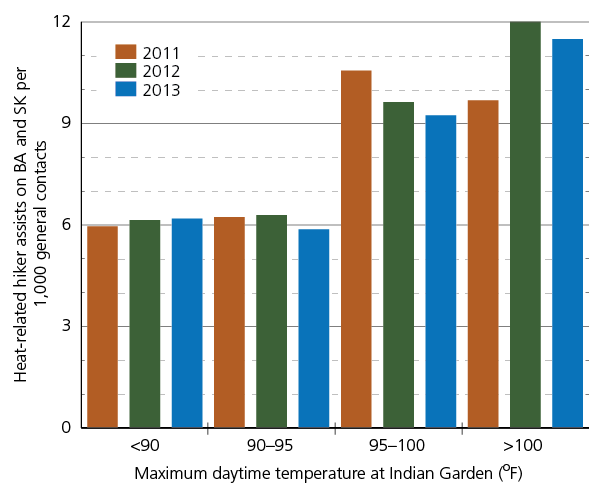
In 2012, nosotros began a comprehensive data assay with the goal of identifying trends and validating long-continuing assumptions. For example, we hypothesized that a physiological environmental temperature threshold exists in hikers who telephone call for assistance; furthermore, at a specific temperature the PSAR team volition experience a marked increase in down-trail distress calls. Nosotros then collected atmospheric condition data from Indian Garden Ranger Station, a middle signal in the canyon that about accurately reflects weather models along the South Kaibab and Vivid Angel Trails. Nosotros compared maximum daytime highs to heat-related hiker assists along both of these trails. Later on, we discovered a strong relationship between heat-related hiker assists and maximum daytime temperatures.
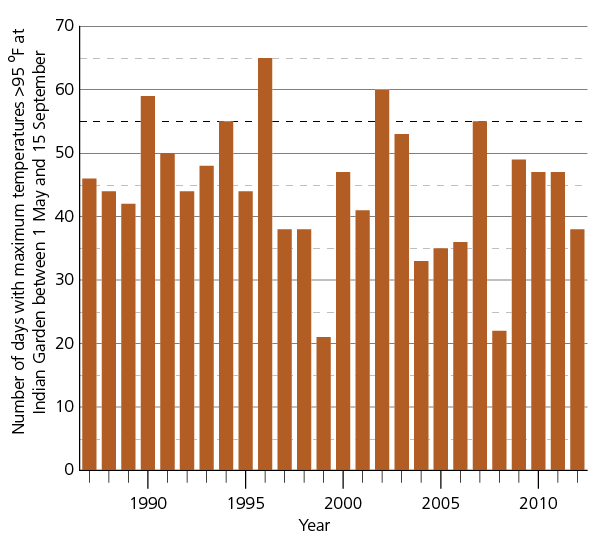
From 2011 to 2013 a consistent pattern reveals a physiological temperature threshold spiking at 95°F (35°C) and hotter (fig. 7). Hiker assists at temperatures beneath this threshold occurred at a rate of half dozen.one estrus-related assists per 1,000 general contacts, whereas at temperatures at or above the threshold, heat-related hiker assists increased to an average of 10.4 per 1,000 general contacts, a 71% increment in distress calls. Historical weather condition data reveal that 1996 had the most days above 95°F of any year in the previous 25; that year holds the record for SARs (482), heat-related fatalities (5), and days in a higher place 95°F (65 days) (fig. 8).
Source: Indian Garden weather condition station
Source: Indian Garden weather condition station
This dramatic increment in hiker assists on days above the temperature threshold has the potential to tax ranger resources to the limit. Rescuer fatigue and resource depletion are serious concerns that chemical compound the possibility of rescuer injury or illness. As Chief Phillips acknowledged, one call and "you're spent for the rest of the twenty-four hour period." Even so, with advanced warning—days predicted at or above 95°F—both PSAR staff and the visiting public tin can profit from improved condom and hiker assist outcomes afforded by amend information gathering and planning.
A big aid to the enhancement of trail safety was the 2014 installation of a new weather station at Indian Garden (EW5243) and the 2015 Phantom Ranch weather condition station (EW9070) replacement of outdated equipment of the National Oceanic and Atmospheric Administration (NOAA) (fig. 9). These modernistic systems allow united states to monitor real-time trail weather condition with added meteorological values being measured to further refine physiological distress in relationship to environmental conditions: solar radiations (likewise called solar power density), which is far more important than temperature lonely in order to describe the physiological burden for hikers); UV index; barometric pressure level; wind speed and direction; dew point; and atmospheric precipitation. Both of these weather stations are continued via a newly installed dish uplink system linked to ranger facilities on the canyon rim and ultimately to NOAA, MesoWest, and PSAR databases. This network is capable of hosting a multitude of future safe-related voice and data services in this remote and austere environment.
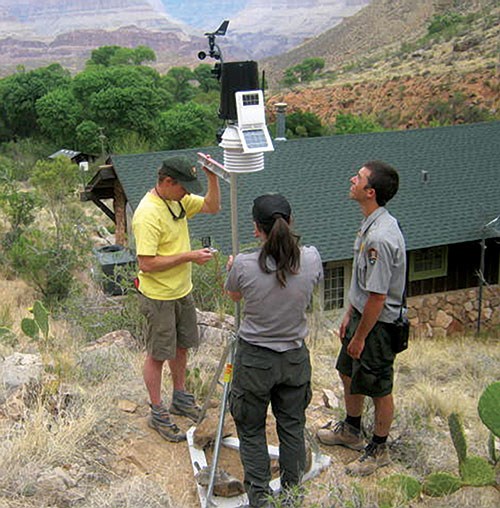
NPS/C. J. Malcolm
This innovative Coulee Emergency Data System (CEIS) was designed, congenital, and installed by Dr. Hannah Heinrich, longtime 1000 Canyon volunteer and chief scientific PSAR advisor. CEIS is in its second year of suspension-complimentary operation with futurity plans of linking atmospheric condition data and other visitor safe–related letters to existent-fourth dimension displays at trailheads, inner canyon ranger stations, visitor centers, and backcountry permitting offices. CEIS can besides provide a publicly accessible Internet presence on the corridor trails. This is a tremendous step toward providing real-time information for the 5 1000000 almanac park visitors.
Every bit data assay continues, the PSAR squad will shape its upcoming staffing based on updated study results: trail patrols and hiker pedagogy will exist reinforced on days above the temperature threshold. During summer 2015 (Norwil et al. 2015), the PSAR team conducted the OMB approved Hiker Hydration Written report evaluating the drinking habits of hikers entering Grand Coulee. More one,000 hikers filled out questionnaires over three weekends with an outstanding 75% response rate. These information are now nether analysis and in draft form.
The goal remains the same: we volition continue to learn and anticipate Grand Canyon hiker habits and trends to reduce visitor injury and death, and we will use our workforce every bit efficiently every bit possible to promote rescuer safety and optimal response to calls for assistance.
Remaining accountable to the public
Everyday PSAR operates a step behind the public. Some visitors brand dangerous plans and casually descend into the canyon with unrealistic goals in mind. Out of the more than 117,000 people our staff encountered during summer 2015, more than than 28,000 required persuasion to adopt different plans. Attempting to influence individuals to change their behavior while they are happily hiking into Arizona'southward nifty chasm takes more than talent. Strong salesmanship, customer service skills, and knowledge of human behavior are cornerstone arts that PSAR rangers must master. Improved training, knowledge of the client—the hiking public—and centering preventive strategies on scientific data remain PSAR's guiding objectives. The more than we learn nearly the motivational values of those who descend into the canyon, the more proactive PSAR can become in developing techniques for educating hikers on improved personal preparedness. Science in concert with a learning organisation approach makes this task easier.
Sources
All information in this article is derived from SAR and acceleration logs at Grand Canyon National Park, interviews with the aforementioned rangers, and findings from original studies designed by the PSAR team. Additionally the Preventive Search and Rescue Impact Written report (cited below) contains much of the cloth for this article. PSAR rangers Emily Pearce and Joelle Baird contributed to this article. Special thank you become to Ken Phillips and Beak Vandergraff.
References
Johnson 5. United States Department of Interior, 949 F. 2nd 332, 60 USLW 2356 (10th Cir. 1992). Federal Reporter, 2d Serial. Available at http://openjurist.org/949/f2d/332/johnson-v-united-states-section-of-interior.
Malcolm, C. J., and H. Heinrich. 2012. Preventive search and rescue impact report. National Park Service, Grand Canyon National Park, Arizona, USA.
Norwil, Eastward., C. J. Malcolm, and H. Heinrich. 2015. Hiker hydration report. Abstruse and summary. National Park Service, Chiliad Canyon National Park, Arizona, USA.
About the author
C. J. Malcolm, with a master'southward in Organizational Leadership, is a former ranger paramedic and PSAR supervisor at Grand Canyon National Park, 2010–2016. He currently works at Gunnison Valley Hospital as a paramedic captain and emergency management coordinator. Hannah Heinrich, PhD, MSCS, is a former volunteer and primary scientific advisor for the PSAR team. Dr. Heinrich currently resides in Federal republic of germany and is a recognized skillful regarding occupational health and safety with the German government and the European Union. She assisted with all data assay and graph creation. Malcolm can be reached by eastward-mail.
Source: https://www.nps.gov/articles/parkscience33-1_99-107_malcolm_heinrich_3864.htm
0 Response to "Death Calls to You Again Ranger How Do You Answer"
Post a Comment